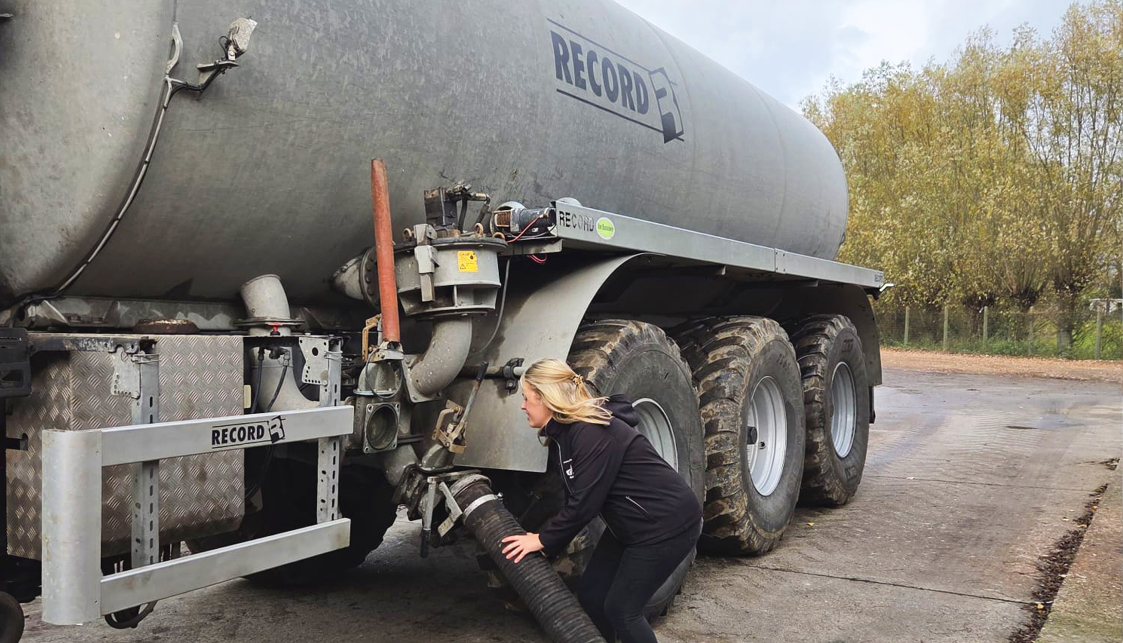
These are passive ways to track your business assets. It is passive because the sensors (or tags) themselves do not automatically send a signal like active technology like GPS or BLE. Instead, a user must scan the tag with a smartphone or other device to record or retrieve data. This makes it especially useful for situations where you want control over when and how often information is retrieved. The user can scan the code to view all available information linked to this asset online on a management platform.
It is a very good value for money solution if you want to track assets that change location frequently. Bluetooth is also an option and offers more possibilities, but a QR-NFC tag is the cheapest solution. No matter how small or how big, anything you want to track can be tracked with a QR-NFC tag: (waste) container, work equipment, (pool) cars, drills, ...
NFC and RFID technology are very similar; however, NFC aka near field communication does not rely on dedicated scanning devices to get the job done. Instead, employees can simply use their smartphones to track assets and inventory. Convenience, ease of use and efficiency are the main advantages of this method. One drawback to note, however, is that the scanning range for this method is minimal (only a few inches), so it cannot be used from a distance like some of the other methods already mentioned.
Advantages of passive asset tracking:
- Cost-effective: QR-NFC tags are inexpensive to implement and do not require batteries or sophisticated hardware, making them a budget-friendly option for large-scale asset tracking.
- Ease of use: Employees can easily scan assets with their smartphones and capture important information, such as location, maintenance status and property information, without the need for dedicated scanners.
- Flexible: Whether containers, tools, vehicles or other assets, QR-NFC tags can be applied to virtually any type of asset, regardless of size or value.
- No maintenance required: Unlike active technologies such as GPS, passive tags do not require battery replacement or other maintenance, making them highly durable.
Limitations of passive tracking:
- Short scanning range: A disadvantage of NFC technology is that the scanning distance is very short, often only a few centimeters. This means the user must be physically close to the asset to scan it, which can sometimes be inconvenient in larger locations.
- Manual interaction: Passive tracking requires an employee to manually scan the tag to record information. This can be less efficient in situations where continuous real-time monitoring is desired, such as highly valuable or fast-moving assets.
Applications:
Passive tracking is ideal for industries and situations where assets are moved frequently but are not in constant motion, such as in construction, manufacturing, and warehouses. For companies that primarily want to track inventory of tools, machinery, or other equipment, QR-NFC provides an easy way to track assets without the need for expensive technology.
Comparison with other technologies:
- Bluetooth (BLE): Although Bluetooth technology is also flexible and can track assets wirelessly, it is more expensive and requires batteries, which adds maintenance.
- RFID: RFID has a longer range than NFC, but often requires special scanners, which increases costs.
- GPS: GPS is suitable for real-time monitoring of vehicles and moving assets, but is much more expensive and requires energy resources.
Conclusion:
Passive tracking with QR-NFC tags is an excellent solution for companies looking to cut costs and have easy access to important asset information. For assets that do not require constant tracking or remote monitoring, this technology provides a reliable and efficient way to keep control of assets.
Read about AllConnects' asset tracking solutions here.