


Recently, a Dutch court ruling regarding a black box used as a time clock was posted on LinkedIn. The conclusion shared was that this is not allowed. That’s understandable—but the article still calls for further clarification: Under what circumstances is time tracking in a company vehicle actually permitted?
An employer spent months comparing data from a company car’s tracking system with an employee’s time records, found a discrepancy of nearly 95 hours, and terminated him immediately for time fraud. The Arnhem-Leeuwarden Court of Appeals overturned that dismissal. The case came to our attention through a post by Mehtap Melo-Kocyigit on LinkedIn, who clearly summarizes the ruling from the perspective of Dutch labor law.
The ruling does not address the question of whether technology is allowed to track working hours. It addresses the question of whether data collected for one purpose may be reused for another purpose afterward. That is a fundamental difference—and it is precisely the difference that causes problems in practice.
Where Things Really Went Wrong
The court found the employer guilty of several things, and only one of them relates to technology.
The track-and-trace policy was established to manage the company vehicle, not to determine hours worked. When the employer subsequently used the data for that second purpose, he was using it for a purpose other than its original intent.
Furthermore: there had been signs for months, but the data wasn’t analyzed until much later. The employee was never simply asked why his car was parked in front of his house during work hours. Performance issues and suspected fraud were conflated. And the personal circumstances of an employee with thirty years of service were barely taken into account.
In other words: the case was weak long before the technology came into play. Anyone who wants to know why someone’s car is parked at home can simply ask. Collecting six months’ worth of data to answer that same question isn’t more thorough—it’s slower, and legally more tenuous.
What This Means for a Belgian Employer
This is a Dutch saying. It’s instructive, but not directly applicable. Three things are different here.
The clock is ticking faster
In Belgium, a double three-business-day deadline applies to dismissal for urgent cause. You have three days to dismiss the employee, counting from the moment the decision-maker has sufficient certainty regarding the facts. This is followed by another three days to notify the employee of the reason by certified mail. An employer who spends months gathering evidence does not , therefore , lose the deadline. But the employer does lose out significantly.
Your employee's consent won't help you
Under the GDPR, consent is only valid if it is freely given. In an employment relationship, there is a power imbalance, and therefore, in practice, an employee’s consent is rarely accepted as a valid legal basis. So you need something else—and what that legal basis is depends entirely on your purpose.
Time tracking isn't a luxury you allow yourself
In 2019 (CCOO v. Deutsche Bank, C-55/18), the European Court of Justice ruled that employers must have an objective, reliable, and accessible system in place to measure daily working hours. In addition, in Belgium, there are provisions regarding attendance tracking at construction sites via Checkin@Work, the deviation log, the rules governing part-time work, and the mobility allowance under PC 124.
So the notion that digital time tracking is something to be approached with caution is actually completely wrong. Reliable tracking isn’t the risk—sloppy tracking is.
Three entries, not a single one
The confusion arises because three different things are happening in the same vehicle. They may seem similar, but legally they are unrelated.
Vehicle Registration
Objective · Fleet management, fuel, maintenance, theft prevention, tax and insurance obligations
Legal Basis · Legitimate Interest, with Balancing of Interests and Duty to Inform
What You Record · Trips, Locations, Driving Behavior – Vehicle Data
Attendance Tracking
Purpose · Legal attendance tracking, such as Checkin@Work at construction sites
Legal Basis · A Legal Obligation
What you record · who, when, at which construction site
Time Tracking
Purpose · Payroll, working hours, mobility calculation
Legal Basis · Legal Obligation and Performance of the Employment Contract
What to Record · Start and End of the Work Period
Three objectives. Three legal bases. Three datasets. The mistake in the Dutch case was not that the car was equipped with technology. It was that dataset 1 was used to answer question 3—six months after the data had been collected, and without anyone having been informed of this in advance.
Which registration method is right for your construction site?
Driver badge, construction badge, RFID tag, or app: each option has its own strengths, depending on your team and your requirements. We’d be happy to discuss your options with you—no strings attached.
Get adviceWhen Time Tracking in a Company Vehicle Is Permitted
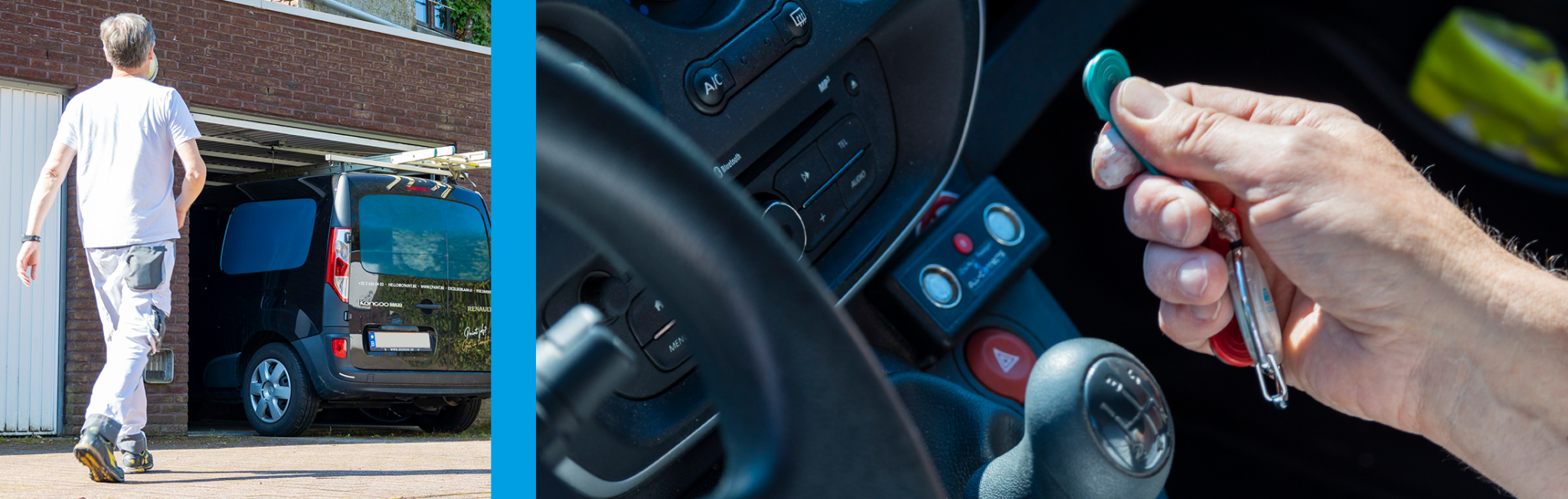
When an employee logs in using a personal driver badge, an RFID or NFC tag, a Construbadge, or an app, something fundamental changes. Not the location of the technology—which is still in or around the vehicle—but the nature of the registration.
The purpose has been clear from the very beginning: to record attendance or performance. The employee takes action on their own. Functionally, it’s the same as swiping a badge at the entrance to a building. And that makes two things possible that were missing in the Dutch case.
You'll register less
For time tracking, you need the employee’s identity, the time, and, if applicable, the work zone. You don’t need the entire time track. A properly configured system therefore only records that specific data for this purpose. That’s not a courtesy; it’s the principle of data minimization.
You separate those who see what
The fleet manager needs vehicle data. HR and payroll need performance data. Those don’t have to—and shouldn’t—be the same screens. Anyone who technically separates those permissions simply makes reuse—which was the stumbling block in this case—impossible.
One caveat: geofencing falls into a gray area. It works based on location, not on an action taken by the employee. It’s useful, but it requires more careful consideration and an explicit explanation. Don’t simply equate it with a badge.
What You Need to Arrange in Advance
Choosing the technology is the easy part. This is the part that makes or breaks the deal:
- Define the goal before you start collecting data —and record each goal separately in your processing log. You cannot expand a goal after the fact.
- Include it in the employment regulations using the amendment procedure provided for that purpose.
- Consult with the works council or the occupational health and safety committee in advance.
- Conduct a DPIA whenever you systematically process employee data. This is the basic principle for geolocation and attendance tracking—the Data Protection Authority publishes a list of such cases.
- Provide your employees with specific information: what data is collected, why, for what purpose, how long it is retained, and who can access it. This varies by purpose—the retention period for trip data is not the same as that for personnel records.
None of these five points is about technology. All five determine whether your technology will stand the test of time.
The technology wasn't the problem
This statement is not a warning against digital time tracking. It is a reminder that a system is only as strong as the process surrounding it.
Those who choose the right tool for the right purpose, define that purpose in advance, and communicate it openly will make perfect use of time tracking in company vehicles —for accurate payroll administration, for tracking attendance on-site, for mobility calculations, or for legal reporting requirements such as Checkin@Work.
Anyone who takes the opposite approach—searching through existing data for an answer after the fact—will sooner or later face the same question as this employer. Only then, it will be in court. Ultimately, it’s not about technology. It’s about clarity, trust, and finding the right solution for the right purpose.
Frequently Asked Questions
It’s not that simple. Data collected for fleet management purposes may not be reused retroactively to determine working hours: that is a different purpose, with a different legal basis. If you want to record working hours, you must use a system that is designed for that purpose from the outset and that has been documented and communicated as such.
Vehicle tracking records data about the vehicle: trips, locations, and driving behavior. Time tracking records an employee’s presence or performance: who, when, and where. The technology may be installed in the same vehicle, but the purpose, legal basis, and retention period are completely different.
Consent is rarely a valid legal basis in an employment relationship because, due to the hierarchical relationship, it is not considered to be freely given. In practice, you rely on a legal obligation or on the performance of the employment contract. However, providing information remains mandatory—which is different from asking for consent.
Yes. Provisions regarding the recording of working hours belong in the employment regulations, and any changes to them must follow a established procedure. In addition, prior consultation with the works council or the CPBW is recommended when introducing a new recording system.
Yes. As long as the employee identifies themselves using a personal device—such as a badge, tag, Construbadge, or app—and the purpose is to record attendance from the start, it functions as a fully-fledged check-in point. The key lies not in the technology, but in the predefined purpose and clear communication about it.
This article is intended to provide general information and does not constitute legal advice. The specific application of time-tracking or vehicle tracking systems depends on applicable labor laws, privacy regulations, and how you implement them within your organization. Therefore, always seek advice on proper implementation.
Source of the discussed ruling: Arnhem-Leeuwarden Court of Appeal, ECLI:NL:GHARL:2026:4034. With thanks to Mehtap Melo-Kocyigit, whose post on LinkedIn served as the inspiration for this article.

Hilde Lavrijssen - Marketing Manager at AllConnects
Closely follows the digitization of fleet management and time tracking in the construction industry and translates these developments into practical insights for companies on the road and at construction sites.
