


From July 1, 2026, the tachograph requirement will apply to certain delivery vans with a maximum authorized mass of 2.5 tons or more. But what does that mean for your fleet in concrete terms? And are there alternatives if you prefer to stay below the limit? On this page, you will find clear answers to the most frequently asked questions.
Need more background information? Read our comprehensive blog: Tachograph mandatory for vans weighing 2.5 tons or more: is it wise to stay below the limit, or not?
A | Legislation on tachograph requirements for delivery vans
Which delivery trucks are subject to the tachograph requirement?
The tachograph requirement for delivery trucks will apply from July 1, 2026, to vehicles that meet the following three conditions:
- They are used for transport for third parties — own transport is not included.
- They have a maximum permissible mass (MTM) of 2.5 tons or more.
- They are active in international transport or carry out cabotage.
Do you only drive nationally and for your own account? Then your delivery van is not covered by these regulations for the time being. Are you unsure whether your activities fall under 'transport for third parties' or 'cabotage'? Consult the official text of the European Mobility Package here or contact AllConnects for a fleet analysis.
Does the tachograph requirement also apply to delivery trucks that only drive nationally?
Not for the time being. The current regulations from the European Mobility Package focus on international transport and cabotage. Purely domestic transport for own account is exempt.
Please note: the legislation may be extended to national transport in the future. It is wise to prepare your fleet now for a possible further rollout.
When must the tachograph for vans over 2.5 tons be installed exactly?
The deadline is July 1, 2026. Installers' schedules fill up quickly as the deadline approaches, so start planning early. Also, keep driver cards in mind: your drivers will need a personal tachograph card and will need to get used to the new registration requirement.
What exactly is a Type 2 Smart Tachograph?
A Smart Tachograph type 2 records:
- Driver driving and rest times
- Border crossings
- Loading and unloading activities
- Location data via GNSS (GPS)
Enforcement agencies can remotely read the data via DSRC without the vehicle having to stop. Companies are required to download the data regularly — from January 1, 2025, drivers must keep 56 days of driving data on board.
B | FAQ about weight, limits, and alternatives
What if the weight of my delivery van sometimes exceeds 2.5 tons?
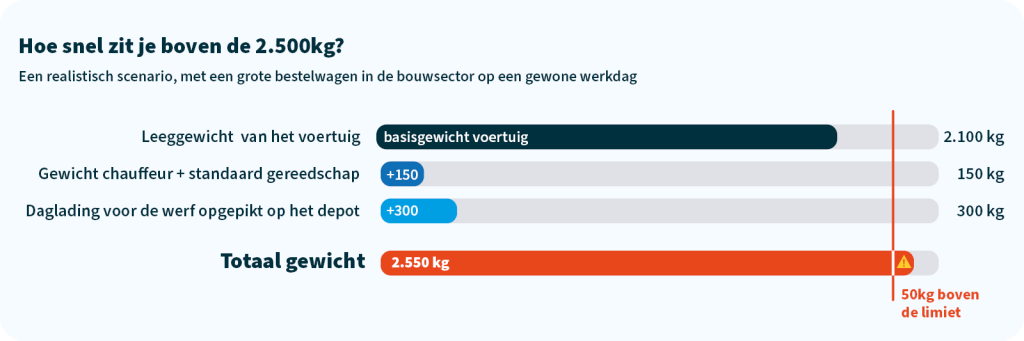
Then you are in a risk zone. Does your van occasionally exceed 2.5 tons, and is it used for transport for third parties or for international journeys? Then you are, in principle, subject to the tachograph requirement.
There are two ways to deal with this:
- You install a tachograph — then you are always compliant, regardless of weight.
- You actively monitor the load weight and ensure that you remain below the limit at all times — with digital weight monitoring as proof.
Important: "We think we are below the limit" is not a valid defense during a roadside check. You need verifiable data. Weigh in Motion (WIM) sensors on Flemish highways automatically detect every passing vehicle—as a result, the chance of being caught for overloading has already increased from 15% to 83%. Read our blog about the introduction of Weigh in Motion in Belgiumhere.
How accurate is a digital weighing system for delivery trucks?
Digital weighing systems that measure axle load using air pressure sensors achieve an average deviation of less than 2%. This is accurate enough for preventive compliance with weight limits.
By way of comparison, a driver who estimates the weight "by feel" can easily be 200 to 300 kg off the actual weight — especially when the load profile varies from day to day.
The weighing systems that AllConnects integrates with the FLEET.connect platform send the weight data to the fleet dashboard in real time. This allows dispatchers to see at a glance which vehicles are close to the limit, even before they leave.

Overloaded vehicles mean risk: high fines, faster wear and tear and unexpected lost time. With real-time weight monitoring, you always know exactly how much your vehicles are loaded - even before the police do.
Which vehicle types are compatible with a digital weighing system?
Most vehicle types are compatible with:
- Vans and light trucks with air or leaf suspension
- Trucks and tractors with air suspension
- Trailers and semi-trailers
Not sure if your vehicle is compatible? AllConnects performs a free compatibility check as part of the fleet analysis.
What is the difference between a WIM system and a digital weighing system in my vehicle?
Weigh in Motion (WIM) are sensors in the road surface on highways, managed by the Flemish road inspection authority. They measure the weight of every passing vehicle from the outside—you have no control over them and you cannot see the measurement.
A digital weighing system in your own vehicle works in reverse: it measures continuously and in real time from the axle of your own van and sends that data to your FLEET.connect dashboard. This means you are the first to know when a vehicle is approaching the threshold value — and you can take action before a fine is issued.
C | Cost and investment of a digital weighing system
How much does a digital weighing system linked to FLEET.connect cost?
The price depends on three factors: the number of vehicles in your fleet, the type of suspension system (air or leaf suspension), and the desired features in the FLEET.connect dashboard.
You will always receive a customized quote. However, you can use the following as a basis for comparison:
- A fine for overloading can be as high as €6,000 per inspection — one incident alone pays back the investment.
- Reduced wear on tires and axles results in additional cost savings in the long term.
- The combination with FLEET.connect means you don't need a separate platform: weight data is integrated into your existing fleet dashboard.
→ Request a personalized quote via all-connects.be/contact-quote
How much does a Type 2 Smart Tachograph cost for a delivery van?
The cost of a Smart Tachograph type 2, including installation, varies depending on the installer and vehicle type. On average, you can expect a significant one-time cost per vehicle, in addition to the recurring costs for reading the data.
AllConnects also offers tachograph data download as part of FLEET.connect — allowing you to read the tachographs of your entire fleet automatically and remotely, without manual intervention.
Is your question not answered here?
The AllConnects team is happy to help you—whether you need a tachograph or would prefer a way to monitor that your fleet remains below 2.5 tons. Ask your question or request a free fleet analysis:

Hilde Lavrijssen
Marketing Manager — AllConnects BV
Hilde closely follows Belgian legislation on mobility, fleet management, and time tracking and translates it into practical insights for companies in the transportation industry.
