


From July 1, 2026, a new European requirement will apply to tachograph delivery trucks weighing 2.5 tons or more: anyone who is employed for third-party transport, drives internationally, or performs cabotage must be equipped with a Type 2 Smart Tachograph.
The initial reaction of many transport managers and business leaders? Understandable and predictable:
"We just drive under 2.5 tons. Then we don't have any problems with that."
But is it really that simple? And do you actually know exactly how much the delivery trucks in your fleet weigh at any given moment—with cargo, driver, and equipment on board?
What exactly does the legislation say about tachographs for delivery trucks?
From July 1, 2026, the European Mobility Package will require the use of a Smart Tachograph (type 2) for vans that meet the following three criteria:
- Used for transport for third parties (no own transport)
- With an MTM of 2.5 tons or more
- Active in international transport or cabotage
Private transport is not covered by the new regulations. The tachograph records driving and rest times, border crossings, and loading and unloading activities. Enforcement authorities can read this data remotely via DSRC—without the vehicle having to stop.
Click here for official information on the European Union website.
The pitfall with tachograph delivery trucks: "we drive under 2.5 tons"
Staying below the limit seems like the logical solution. And for some companies, it may indeed be a valid strategy — provided you effectively monitor that limit.
Consider the following realistic scenario:
- Unladen weight of a typical large delivery van: ± 2,000–2,200 kg
- Driver + work equipment + tools: easily 150–200 kg
- Load: depending on the day and assignment, but for construction or delivery, quickly 300–500 kg
- Total: you will exceed 2,500 kg faster than expected
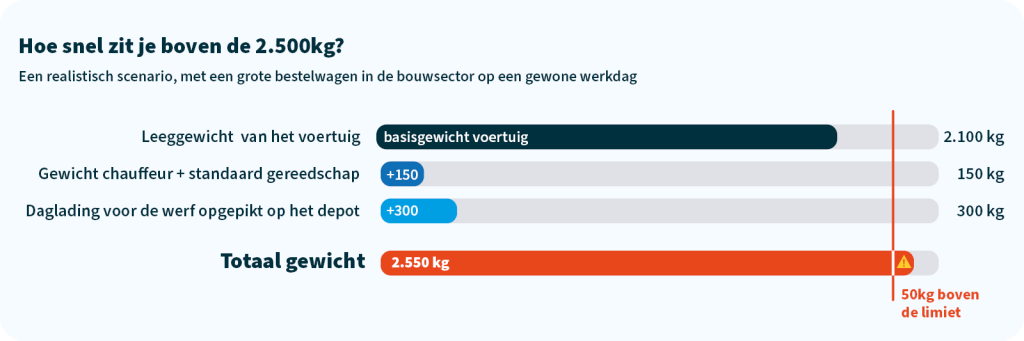
The question is not whether you want to drive below the limit. The question is whether you are sure of that at the moment your driver drives out of the gate with the loaded delivery van.
The chance of being caught is higher than ever: Weigh in Motion in Belgium
This is where it gets concrete. Flanders is investing heavily in Weigh in Motion (WIM) technology: sensors embedded in the road surface on highways that automatically record the load weight of every passing vehicle —without the driver having to stop.
The result? The efficiency of weighbridge checks increased from 15% to 83%. Instead of 5 out of 100 trucks being checked, more than 8 out of 10 are now checked—completely automatically, day and night.


A vehicle carrying excessive loads, which in the past might have passed the checkpoint unnoticed, is now automatically flagged. The traffic police are then deployed specifically to target vehicles with the highest probability of carrying excessive loads.
And the consequences of overloading are significant:
- Fines of up to €6,000 per inspection
- The vehicle must not continue driving.
- Loss of time, additional transport and personnel costs
- Reputational damage
- Accelerated wear and tear on tires, suspension, and axles
The smart approach: digital weight measurement, visible in real time in your fleet dashboard
Anyone who consciously chooses to stay below 2.5 tons as a business strategy needs one thing above all else: certainty. No well-intentioned estimates, no driver experience, but hard data.
AllConnects, in collaboration with specialized partners, offers an integrated solution: a digital weighing system that uses air pressure sensors to measure the exact axle weight and transmits that data in real time to the FLEET.connect dashboard. No manual intervention is required, and the driver does not need to do anything. Discover how real-time load weight control works for your fleet.
How does weight measurement work?
- Air pressure sensors are installed on the vehicle and continuously measure the axle load.
- This data is transmitted in real time to your fleet management platform via the FLEET.connect tracker.
- Is a vehicle at risk of being overloaded? You will receive an immediate notification — even before the vehicle departs or reaches a checkpoint.
- Historical data allows you to analyze loading patterns and further optimize your logistics planning.
The measurement accuracy is on average less than 2% deviation — a reliable basis for staying below the legal limit with confidence.

Who is this relevant for?
- Construction companies with delivery trucks that transport varying quantities of materials
- Transport and logistics companies with light vehicles close to the 2.5-ton limit
- Service and distribution companies that make multiple stops daily with variable loads
- Any company that wants to proactively manage its fleet and avoid fines
Installing a tachograph or monitoring load weight: what is the right choice for your business?
There is no universal answer. It depends on your specific situation: what type of vehicles you use, how much you load, and whether you operate internationally.
Do your drivers regularly transport loads that could easily be kept below 2.5 tons? Then load weight monitoring is a smart and inexpensive solution to ensure compliance and avoid fines.
Are your loads regularly close to the border, or do your drivers drive internationally for third parties? Then the tachograph is the only legal option.
Click below to read more about these two solutions:
Do you have a mixed fleet? Then it is worth analyzing each vehicle individually.
Conclusion: tachographs for 2.5-ton delivery trucks? Staying below the limit requires proof
The tachograph requirement forces companies to make more conscious choices about their fleet management. Those who strategically opt for vehicles under 2.5 tons are right — but they must also substantiate this with hard data.
During a roadside inspection, "we think we're below the limit" is not a valid answer. Real-time load weight data in your fleet dashboard is.
AllConnects helps you make the right choice for every specific situation — and implements the solution that fits.
Would you like to know whether under 2.5 tons is realistic for your fleet?
Request a free fleet analysis and discover which approach is most cost-effective for you.
Do you have any questions about the tachograph requirement for delivery trucks?
We have compiled the most important FAQs in a separate blog. Click here to read the blog.

Hilde Lavrijssen
Marketing Manager — AllConnects BV
Hilde closely follows Belgian legislation on mobility, fleet management, and time tracking and translates it into practical insights for companies in the transportation industry.
